Kinesiology vs acupuncture, compared fairly
Two hands-on practices people often weigh against each other, and they work in genuinely different ways. Here is a fair read on both, so you can pick the one that fits you, not the one with the better marketing.
What Each One Is
Different roots, different mechanism
Kinesiology grew out of work by a Detroit chiropractor, Dr George Goodheart, who in 1964 noticed that manual muscle testing could do more than grade strength, it could give a window into the body’s responses. That idea became applied kinesiology, the system Goodheart founded that year. The branch practised at Intelligentle Healing, PKP, was developed in the 1980s by Dr Bruce Dewe, a New Zealand medical doctor, and his wife Joan Dewe. It works with the nervous system and uses muscle monitoring as its feedback signal, no needles involved.
Acupuncture comes from traditional Chinese medicine and has been practised for thousands of years. A practitioner inserts very fine needles at defined points on the body. The traditional framework describes those points as sitting along meridians that carry qi, the body’s vital energy, though many modern practitioners and researchers also explain the effects in terms of the nervous system and the body’s own pain-relieving chemistry. Unlike kinesiology, there is no muscle-monitoring step, the needles do the work.
So one reads the body’s live responses and stays needle-free. The other works by needling defined points. Different roots, different mechanism.

Side by Side
The quick comparison
The same seven dimensions, read across both practices. Neither column is the winner, they are just different.
The Short Version
Three things that actually separate them
The core difference
Needles, or a feedback loop
Kinesiology reads your body as it goes, gentle muscle monitoring shows where stress sits, and the session follows that. No needles.Acupuncture works by inserting fine needles at traditional Chinese medicine points.That single difference shapes everything else.
The experience
Receiving needles, or an interactive session
In kinesiology you hold light positions and your body steers the session, fully clothed and needle-free.In acupuncture, needles are placed and you rest while they stay in.
Choosing
Neither is “better”
Want a needle-free, feedback-led session? Kinesiology.Comfortable with needles and after a longer track record? Acupuncture.Plenty of people use both.Both are used as complementary approaches, and results vary.
How a Session Differs
One reads your body, one uses needles
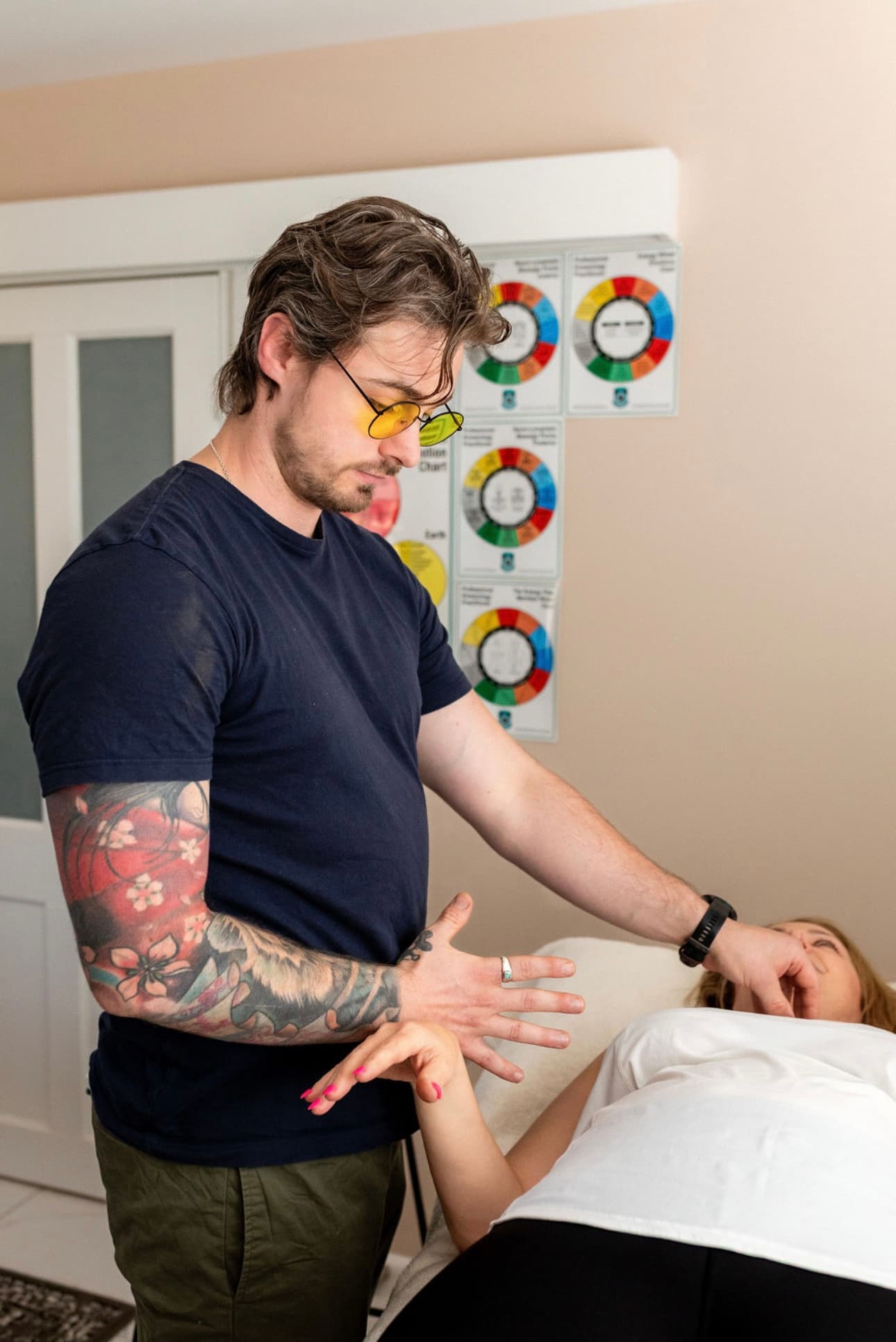
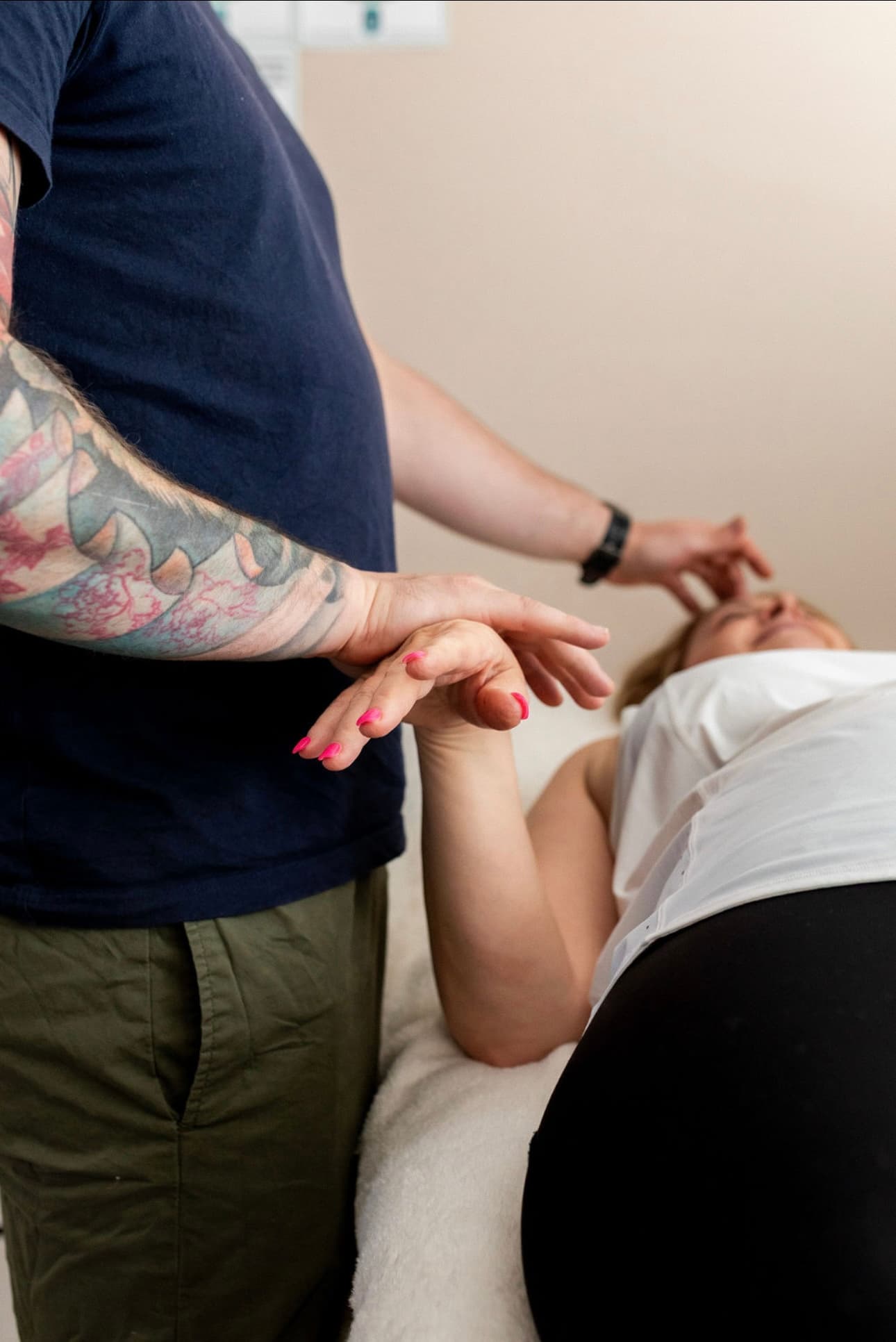
In a kinesiology session, you talk first, then lie on a table fully clothed. I test specific muscles using light pressure while you hold a position. This is not a strength test. It reads how the nervous system is responding, and where a muscle shows a different response, that points to stress held somewhere in the system. From there the session follows what your body shows, using techniques like acupressure points, gentle movements, or breathwork. The feedback is the steering wheel, and there are no needles.
That interactive, needle-free part is what surprises people the first time. A client, Priya, wrote in her Google review: “As someone who’d tried everything for anxiety (therapy, medication, meditation), kinesiology with Vildan was the missing piece. He works at a level nothing else had reached.”
In an acupuncture session, the practitioner inserts fine needles at chosen points, often in the arms, legs, hands, or along the back, and leaves them in place for a set time while you rest. Most people feel only a small prick, if anything. There is no muscle testing and nothing for you to hold. The experience centres on the needling itself.
The headline difference: kinesiology is interactive and needle-free, your body is part of the conversation. Acupuncture works through the needles.
Both can be sensible starting points. People often lean toward kinesiology when they want a needle-free session that responds to their body and works with the nervous system directly, which is one reason some look into kinesiology for anxiety rather than a needling-based approach.
Others lean toward acupuncture when they are comfortable with needles and drawn to its longer track record, especially for pain. If you are weighing a kinesiologist in Melbourneagainst an acupuncturist, the question is less “which is better” and more “which approach do I want right now.”
How to Choose
A few honest filters
- Needles, or needle-free? Acupuncture works through fine needles. Kinesiology uses none at all, so if needles are a hard no, that settles it.
- Do you want feedback, or a chosen protocol? Kinesiology reads and responds to your body as it goes. Acupuncture follows point selections the practitioner decides on.
- What are you bringing? Acupuncture has the broader evidence base, especially for pain. Kinesiology suits people who want a structured, nervous-system approach, often when talk-based approaches haven’t shifted things.
- Are you happy to try and see? Many people sample both before settling, or use them side by side. Neither choice is permanent, and neither rules out the other.
An Honest Word on the Evidence
Where they stand, and what the evidence says
In Australia, the two sit differently, and it is fair to say so plainly. Acupuncture is a registered health profession: acupuncturists who practise as Chinese medicine practitioners must be registered with the Australian Health Practitioner Regulation Agency (AHPRA) under the Chinese Medicine Board of Australia, which has overseen national registration since 1 July 2012. As the Victorian Government’s Better Health Channel puts it, anyone who wants to practise acupuncture in Australia must be registered to do so. Kinesiology is different: it is a complementary, unregistered practice and is not registered with AHPRA. On regulation, the two are not equivalent.
On the research, acupuncture has the larger, though still mixed, evidence base. The US National Center for Complementary and Integrative Health notes that acupuncture can help with some pain conditions and is generally accepted as helpful for chemotherapy-related nausea and vomiting, while results for many other uses are inconsistent. A Cochrane review found acupuncture effective for frequent episodic or chronic tension-type headache, and a large 2018 individual-patient meta-analysis concluded that its benefit for chronic pain is real and not explained by placebo alone, even as non-specific factors also contribute. Kinesiology’s evidence base is more limited. Both are used as complementary approaches, so keep your GP involved for any health concern, and remember results vary from person to person.
Frequently Asked Questions
Common questions about kinesiology and acupuncture
What is the difference between kinesiology and acupuncture?
Kinesiology uses gentle muscle monitoring as a feedback tool to read how your nervous system responds, then works from what your body shows, with no needles. Acupuncture inserts fine needles at defined points, drawing on a traditional Chinese medicine framework of meridians and qi, and increasingly on Western neurophysiological explanations too. The clearest difference is the feedback step and the needles: kinesiology builds each session around your body's live responses and stays needle-free, acupuncture works through needling.
Is kinesiology or acupuncture better for anxiety or stress?
Neither is objectively better, and results vary. People who want a needle-free session that responds to their body’s signals and works with the nervous system often prefer kinesiology, which is why some look specifically for kinesiology for anxiety. People who are comfortable with needles and want a practice with a longer track record sometimes choose acupuncture. The right fit depends on what you are looking for, not on one modality outranking the other.
Can I do both kinesiology and acupuncture?
Yes. Many people use complementary approaches alongside each other, and the two are not mutually exclusive. Some alternate between them, others add one to support the other. Neither is a substitute for medical advice, so keep your GP in the loop for any health concern.
Are kinesiology and acupuncture medical care?
This is where they differ. Kinesiology is a complementary modality in Australia and is not registered with AHPRA, so it is not medical care and does not replace a doctor. Acupuncture is different: when it is practised by a registered Chinese medicine practitioner, it is an AHPRA-registered profession under the Chinese Medicine Board of Australia, so acupuncturists are regulated health practitioners. Even so, acupuncture is generally used as a complementary therapy alongside conventional care rather than in place of it. For any health concern, keep your GP involved.
Does acupuncture have evidence behind it?
It has a larger evidence base than kinesiology, and it is mixed. Reviews from bodies like the US NCCIH and Cochrane find acupuncture can help some conditions, with chronic pain, tension-type headache, and nausea after chemotherapy or surgery among the better-supported ones, while results for many other uses are inconsistent. A large 2018 individual-patient meta-analysis found a real benefit for chronic pain that is not explained by placebo alone, though non-specific factors also play a part. Kinesiology’s evidence base is more limited. Both are used as complementary approaches, results vary, and neither is a substitute for medical care.
Sources
- Acupuncture: What You Need To Know (US NCCIH) (nccih.nih.gov)
- Acupuncture, including practitioner registration (Better Health Channel, Victoria) (betterhealth.vic.gov.au)
- Acupuncture for preventing tension-type headaches (Cochrane Review) (cochrane.org)
- Acupuncture for chronic pain: update of an individual patient data meta-analysis (J Pain, 2018) (pmc.ncbi.nlm.nih.gov)

The Kinesiology Side
If the needle-free, feedback-led approach is the one for you
The comparison is the easy part. The harder, more useful question is whether kinesiology fits what you are carrying right now. I practise PKP, trauma-informed, in Moorabbin and online across Australia, and the work moves at the pace your nervous system sets.
Not sure yet? That is what a first conversation is for. Read my story, or book a free clarity call below.
Curious about the kinesiology side?
If a needle-free, feedback-led approach sounds like the fit you are after, the simplest next step is a conversation. I practise PKP kinesiology in Moorabbin, with online sessions available across Melbourne.
Kinesiology is a complementary health practice and is not a registered health profession in Australia. Sessions are not a substitute for medical advice or treatment.