You took the holiday
Two weeks off, properly switched off. By the second morning back the shoulders were up around your ears again. Rest helped for a moment, then the setting reset itself.
Stress Management Kinesiology
The holiday, the apps, the extra training. They all help for ten minutes, then the tension is back. When stress stops being a feeling and becomes a setting, you change the setting, not the schedule, and that happens in the body. I am a kinesiologist, not a therapist or GP, and this work sits alongside them.

When The Usual Fixes Stop Working
Most stress advice manages the moment and leaves the setting untouched. You are not lazy and you are not doing it wrong. You have tried the things that are supposed to work, and they each help for a bit before your system snaps back to switched on. Three versions people describe most.
Two weeks off, properly switched off. By the second morning back the shoulders were up around your ears again. Rest helped for a moment, then the setting reset itself.
Breathwork, meditation, the cold shower, the steps. Each one works for ten minutes. None of them reach the part of you that stays switched on whether you do them or not.
More exercise to burn it off. It takes the edge off the day, then you lie awake anyway, wired, calculating tomorrow. The stress is not in your schedule, it is in your wiring.
Who This Is For
This is for busy professionals carrying stress that no longer switches off. You manage the deadlines and the household, and underneath it your body never quite drops out of gear. Left unmanaged, that constant load in high performers is exactly what tips over into executive burnout. If you have tried the usual fixes and still feel switched on, that is the signal this work is built for.

How Body-Based Kinesiology Helps
A stressed nervous system does not respond to better planning, it responds to safety.You can manage your calendar perfectly and still feel braced all day.PKP Kinesiology works at the level where the stress lives, using muscle monitoring as a feedback tool to read what your body is holding and what it is ready to let go of.
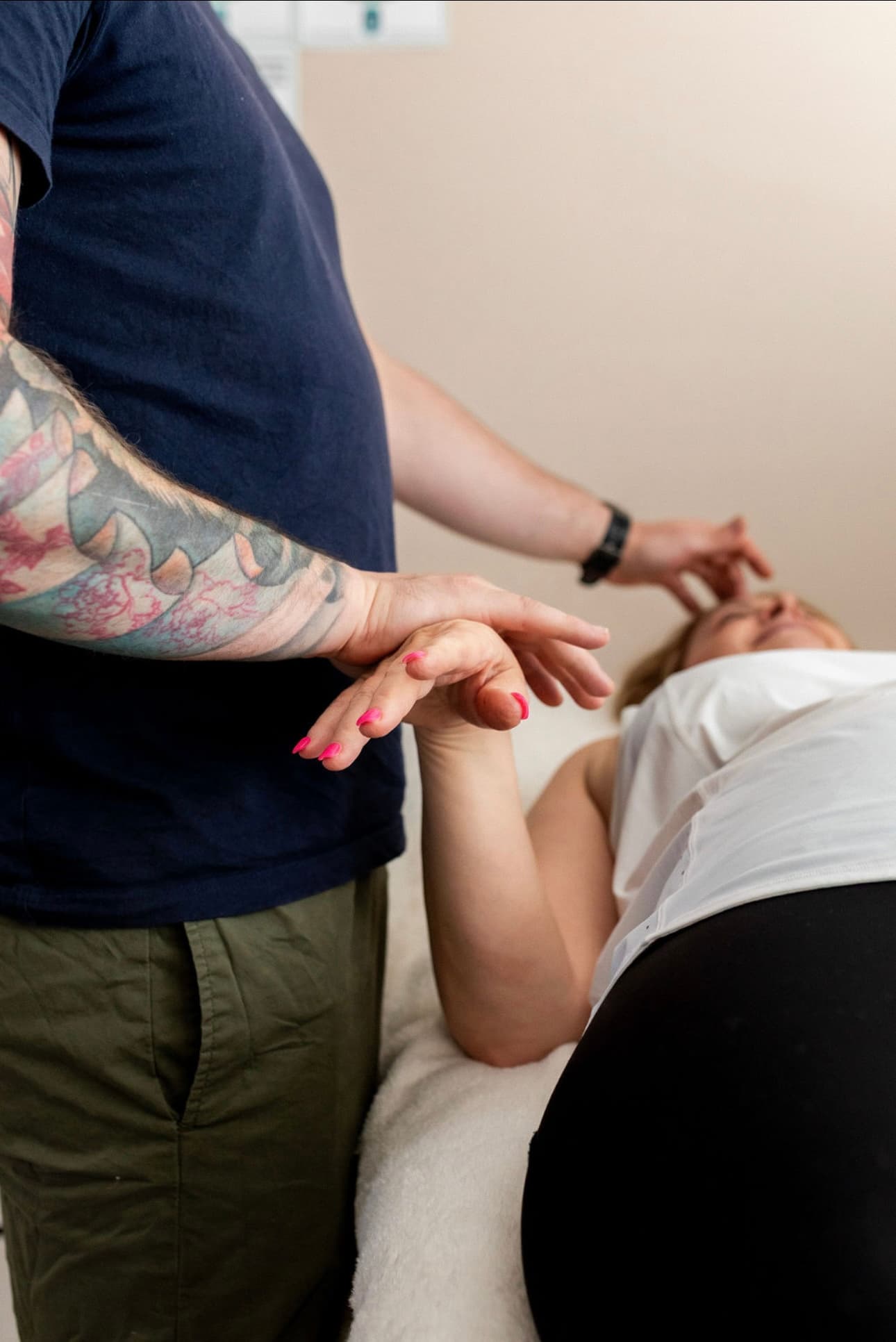
Gentle muscle monitoring reads where your body is carrying the most stress load.You stay fully clothed on a padded table. Nothing has to be explained.
Targeted techniques help your body let go of the pattern it has been holding, so the stress signal can finally stand down instead of running in the background.
Session by session, your resting state shifts from switched on to settled.The stress still comes, you just stop living inside it. Deeper patterns take more sessions. Results vary.
How It Compares
Apps work through a habit you have to keep up. Talk therapy works through the story and the strategy. Kinesiology works through the body, using muscle monitoring, with nothing you have to explain. Most people who book have already tried at least one of the other two.
| Apps and breathwork | Talk therapy | Kinesiology | |
|---|---|---|---|
| Works through | A daily practice you have to remember | The story, the reframe, the strategy | The body, using muscle monitoring |
| You have to | Keep the habit going | Talk it through | Turn up and lie down. Nothing has to be said |
| Best at | Taking the edge off in the moment | Understanding the pattern and changing how you meet it | Settling a stress response that stays switched on |
| Falls short when | The setting resets the moment you stop | Insight lands and the body stays braced | You want a diagnosis, a plan for a condition, or medical care |
| Who runs it | You, on your own | A registered psychologist or counsellor | A kinesiologist, unregistered, alongside your GP |
Read the last row first. A psychologist is a registered professional delivering treatments with evidence behind them, and a kinesiologist is not a substitute for one. If an app or a therapist is helping you, keep going. This work sits alongside them.
What You Actually Get
One-on-one time with me, a muscle-monitoring read of where your body is carrying the stress load, hands-on work to help it release, and a plain read on whether more sessions would help. No homework you have to keep up, and nothing you are required to talk through.
Want structured longer-term work? The Embody & Lead programme runs over several months. Costs are all on the pricing page, in full, with no extras added later.

Trauma-informed PKP Kinesiologist. I work with professionals across Bayside Melbourne who are running on accumulated stress nobody else can see. I do not hand you another routine to keep up, I read what your body is holding and work with that.
The Intelligentle Method
The Intelligentle Method lowers your stress by working with your body, emotions and nervous system at the same time, instead of only talking about what is wrong. New to it? Read the full first-session walkthrough.
A focused 75 minutes to understand the stress you are carrying and how your body is holding it.
Muscle monitoring guides the work. We meet what your body shows us, at the pace it sets.
We shape the pathway forward so a calmer baseline carries into how you live day to day.
In person in Moorabbin or online across Australia.
I’ve been getting regular session as my work is highly stressful and it can lead to burnout quickly. I’ve noticed since working with Vildan my ability to process both emotions and stress has dramatically improved. I no longer get annoyed/irritated by things that before would taken up valuable mental realestate and energy! If you’re in a high pressure role, this will be of great benefit in keep and improving performance and edge.
Vildan has an incredible ability to hold space without judgment. After just two sessions I noticed I was responding to stress differently, calmer, clearer, more grounded. Genuinely life-changing work.
I highly recommend Vildan and his work. Each session leaves me feeling calm and uplifted, with a renewed sense of optimism. His approach is both safe and insightful, creating a space that feels supportive for my growth.
I highly recommend booking in and having a few appointments with Vildan. He has helped me feel more grounded and secure.
He is a master at his craft, incredibly down to earth and highly intuitive. He listens and guides and creates a really safe space that you can explore yourself and what drives you. The session was powerful but light.
I am so glad I found Vildan when I really needed help after realising I was suffering from burnout amongst other unknown blocks in my life. Vildan approaches the challenges you know with skill and empathy, and certainly finds ones you may not know! After just 3 sessions, I feel so much better, clearer, confident,calm and grounded. Life again, is something to live and enjoy!
Frequently Asked Questions
Stress management is one of the most common reasons people come to Intelligentle Healing in Moorabbin. Instead of working on stress at the level of thoughts and to-do lists, kinesiology works with the body, where the stress response lives. I’m Vildan Alihodzic, PKP Kinesiologist, and I use muscle monitoring to find where your system is carrying the most load and help it let go. Clients commonly report leaving calmer, with the change building across a course of sessions. Results vary. PKP Kinesiology is a complementary health practice, not a substitute for medical advice.
If you are searching for a stress therapist, what you really want is to stop feeling stuck on high. A GP can rule out anything medical, and a psychologist or counsellor works with stress through talk and strategy, which many people find valuable. I’m a kinesiologist, not a therapist or medical practitioner, and I work differently: through the body, using muscle monitoring to read where your nervous system is carrying the load and help it downshift, with no requirement to talk anything through. For many people the two approaches complement each other. If a GP or psychologist is already helping, keep going. Results vary.
Apps and talk therapy work through the mind, the breathing exercise, the reframe, the conversation, and many people get real value from them. PKP Kinesiology works through the body. It reads the nervous system for where stress is held and helps it downshift, with no requirement to talk anything through or remember to do a daily practice. At Intelligentle Healing, I see this as a complement to those tools, not a replacement. If an app or a therapist is helping, keep going.
Because most stress advice manages the symptoms while the setting stays the same. Holidays, exercise and meditation can all help in the moment, but if your nervous system has learned to stay switched on, it returns to that baseline the moment the holiday ends. I use muscle monitoring to work at the level of that baseline rather than the daily symptoms, which is why the work can shift things the usual fixes have not reached. Results vary.
A first session at Intelligentle Healing in Moorabbin runs 75 minutes. I take a brief history of the stress you want to address, then use muscle monitoring to find where your body is holding the most load. You lie fully clothed on a padded table. Sessions are calm and structured, and nothing needs to be verbalised. Most people leave noticing a shift. Follow-up sessions run 60 minutes and build on what is already in motion.
There is no fixed number. Many clients notice a shift in their first session, and stress that has been building for years usually takes more. Most people start with four to eight sessions and reassess from there. I give an honest read after your first session, so a single initial session is enough to tell whether the work is right for you. Results vary.
It is built for stress that stopped being a passing feeling and became a permanent setting, the kind you carry into the weekend and into sleep. People often arrive after months or years of holding it together, when the usual stress tips no longer touch it. If high-pressure work has left you running on accumulated stress that never quite drops, that is the pattern this work is built for. For ordinary short-term stress, simpler tools may be all you need.
Generally no. Since the 2019 Australian private-health-insurance reforms, kinesiology was removed from the natural-therapy rebates, so it is usually not claimable on extras cover. Funds and policies differ, so it is worth checking directly with your own fund before booking. Intelligentle Healing is not an AHPRA-registered provider, and sessions are not a substitute for medical care.
Book the 75-minute initial session with me, in Moorabbin or online across Australia. Not ready to commit? The free 30-minute clarity call costs nothing and ends with an honest read on whether this is a fit.
Kinesiology is a complementary health practice and is not a registered health profession in Australia. Sessions are not a substitute for medical advice or treatment.