You always know where the exits are, and you can read a room before anyone speaks. You'd call it being switched on, but it may be hypervigilance.
As a PKP kinesiologist in Moorabbin, I see this pattern a lot. Here's what it is, how to spot it, and when it needs a doctor.
What is hypervigilance?
Hypervigilance is being on guard for danger all the time, even when the real risk is low. A 2019 study in Health Affairs agrees. It defined hypervigilance as being constantly on guard to detect potential danger, even when the risk of danger is low.
You don't choose it. Your autonomic nervous system does the scanning. It's the part that runs your heart rate and breathing without asking you. One large US health service calls hypervigilance a basic human survival mechanism that lets us sense threats to our safety.
So the alarm isn't broken. It has stopped switching off, which is one common shape of a dysregulated nervous system. People often walk into my clinic calling themselves "too intense" or "a worrier". What I see is a body doing a job it learned well.
What are the signs of hypervigilance?
The signs of hypervigilance show up in your body, your attention and your habits, often all at once. Australia's government health service lists frequently scanning the environment for signs of danger. Being easily startled, irritable behaviour, difficulty sleeping and poor concentration are on the list too.
| Sign | Day to day | What's driving it |
|---|---|---|
| Scanning | You sit facing the door | Attention on threat |
| Quick startle | You jump at a dropped pen | A body primed to react |
| Light sleep | You wake at small sounds | Arousal that stays high |
| Tight body | Clenched jaw, raised shoulders | Muscles braced to move |
| Mood reading | You study faces for trouble | Scanning turned on people |
A few of these in a hard week is ordinary stress. The pattern to watch is most of them, most days, with a short fuse at home and no clear reason.
Why does your nervous system stay on alert?
Your nervous system stays on alert because scanning for threat feeds itself: the more you look, the more you find. Under stress, your body releases stress hormones such as adrenaline and cortisol that keep you alert. That adrenaline surge helps for an hour. As a way of life, it narrows your window of tolerance.
One lab study shows the loop plainly. Researchers had 71 people look at neutral pictures for 10 seconds each. One group was set up to watch for threat. That group's eyes made more stops, covered more of each scene, and their pupils grew wider. Nothing in the pictures was dangerous.
The authors call it a forward feedback loop. Looking for threat raises anxiety, and anxiety sends you looking again. That's why "just relax" doesn't work. Your body is following an older order to keep you safe.
Is hypervigilance a personality flaw?
No. Hypervigilance is a state your nervous system learned from what it lived through, not a flaw in who you are. It moves with experience, and a flaw wouldn't. In a study of 504 adults, police violence exposure was tied to a 9.8-point rise on a 100-point hypervigilance scale.
You're far from alone in running hot. The Australian Bureau of Statistics found that 3.4 million Australians, or 17.2%, had an anxiety disorder in 12 months.
Many of the people I see are lawyers, doctors and executives, and their work rewards spotting the problem first. The body doesn't clock off from that job at 6pm, which is how high-functioning anxiety often looks. Call it a flaw and you end up fighting yourself. I'd rather ask what would help this body stand down.
What does hypervigilance cost you over time?
Staying on alert costs you sleep, blood pressure and time with the people you love. In the Health Affairs study, the top quarter for hypervigilance had systolic blood pressure 8.6 mmHg higher on average. That's a real cost for a threat that isn't in the room.
Sleep takes the next hit. A 2019 review in Neuropsychopharmacology put sleep disturbance in PTSD at rates as high as 90%. If you know the feeling of waking up at 3am with your mind already running through the day ahead, this is part of why.
Then there's the cost no study counts. You're at the school concert with one eye on the exits, or home for dinner by 7pm without really landing. Years can go past like that, and your family feels it before you do.
When does hypervigilance point to PTSD?
Hypervigilance points to PTSD when it follows a traumatic event and comes with flashbacks, nightmares, avoidance or numbness. On its own, it isn't a diagnosis. For PTSD, the US National Institute of Mental Health requires at least two arousal and reactivity symptoms. They must last at least 1 month, alongside symptoms from three other groups.
Trauma is common, and PTSD is less so. The Australian Institute of Health and Welfare estimates that 75% of Australian adults have experienced a traumatic event. About 11% experience PTSD in their life, and women carry almost twice the risk of men, at 14% against 8%.
Which side of that line you're on is a question for your GP or psychologist. Either way, old stress can stay stored in the body long after the event. That's why the alarm can outlast the danger.
When should you see a GP about hypervigilance?
See your GP if being on alert has affected your work or home life for more than two weeks. Victoria's Better Health Channel says people should seek professional help if they don't feel any better after two weeks. Beyond Blue says to talk to a doctor if you feel very distressed in the first 2 weeks after trauma.
Book a GP visit if any of these fit
If things ever feel unsafe, call Lifeline on 13 11 14 today.
How do I work with hypervigilance in a session?
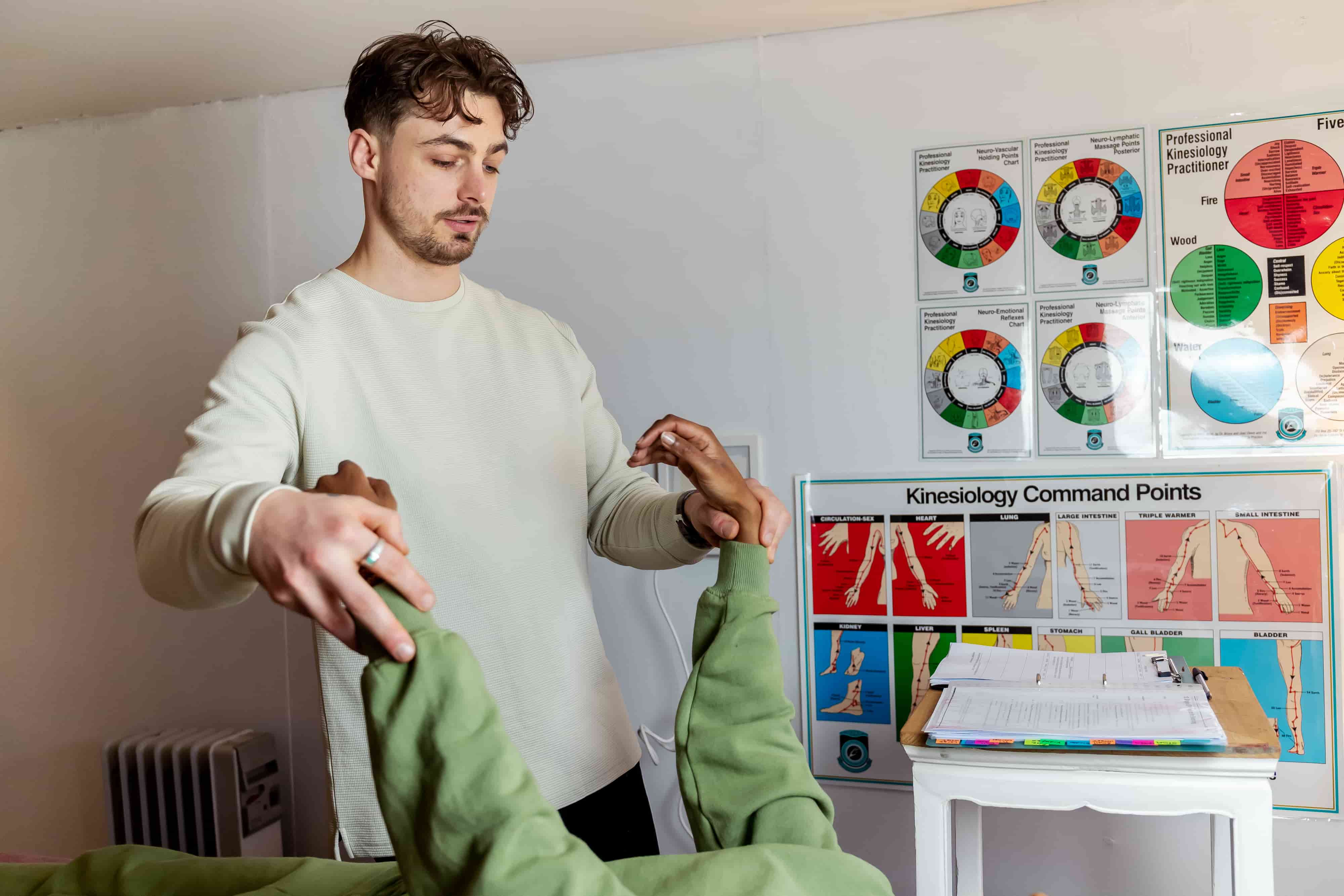
In a session I use gentle muscle monitoring to find where your body is bracing. Then I work at the pace your system allows. A first visit runs 75 minutes, nothing happens without your say-so, and there's nothing special to wear.
What a first session involves
- We talk through what's happening and what your GP has said.
- You lie fully clothed on the treatment table.
- I hold your wrist or arm and press lightly.
- I note where that hold changes, and it guides the nervous system regulation work.
In someone on guard for years, the bracing is easy to see. Shoulders sit high, the jaw is set and the breath stays up in the chest, even lying down. I don't ask you to switch that off, I follow it.
What does a steadier baseline look like?
A steadier baseline means you still notice the door, and then you go back to your meal. The alarm rings for real things and settles after, rather than one big nervous system reset. A 2026 analysis of 15,893 Australians projected lifetime remission from PTSD at 63.3%, so bodies do stand down.
On evidence, I'll be plain. Better Health Channel finds little evidence of the underlying philosophy and claims of benefit for kinesiology. I know of no trial on hypervigilance either. PKP Kinesiology is self-regulated and not AHPRA-registered, as Ahpra's register shows. My work is support alongside your GP or psychologist, and results vary.
If your body is still on watch after reading this, the next step is small. Book a free Clarity Session with me, in Moorabbin or online. It costs nothing, and you can ask me anything first.
Frequently Asked Questions
Is hypervigilance a symptom of anxiety?
Yes, hypervigilance can be a symptom of anxiety as well as PTSD. Among anxiety symptoms, healthdirect lists feeling like you're in danger and feeling that something very bad is about to happen. It also says anxiety disorders affect 1 in 4 Australians at some stage in their life. If it's affecting your everyday life, your GP can work out which it is.
Does hypervigilance affect sleep?
Yes, hypervigilance affects sleep, because a body on guard doesn't drop its watch at night. A 2019 review found sleep disturbance in PTSD at rates as high as 90%. You may wake at small sounds or lie awake checking the house. The same review describes high arousal and poor sleep feeding each other. Tell your GP about broken sleep that lasts more than two weeks.
Is hypervigilance the same as hyperarousal?
Hypervigilance and hyperarousal overlap, but they aren't the same thing. Hyperarousal is the whole wound-up state. Better Health Channel describes it as sleeping difficulties, irritability, lack of concentration and being easily startled. Hypervigilance is the scanning part of it, the constant watch for danger. Think of hyperarousal as the engine running hot, and hypervigilance as the eyes that won't stop checking.
Can hypervigilance go away?
Hypervigilance can ease, and for many people it does. Where it's part of PTSD, a 2026 analysis of 15,893 Australians projected that 63.3% reach remission in their lifetime. healthdirect says trauma-focused therapy may take between 8 and 12 sessions to bring relief from symptoms. How long it takes differs from person to person. Start with your GP, who can refer you to a psychologist.
Can a kinesiologist help with hypervigilance?
A kinesiologist offers body-based support for hypervigilance, not a diagnosis or treatment. In a PKP Kinesiology session at Intelligentle Healing, I use gentle muscle monitoring to find where your body is bracing. You stay fully clothed on a table, and a first visit runs 75 minutes. It sits alongside your GP or psychologist, and you can start with a free clarity call.